

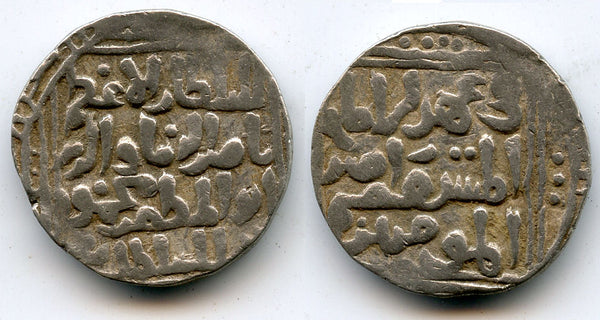
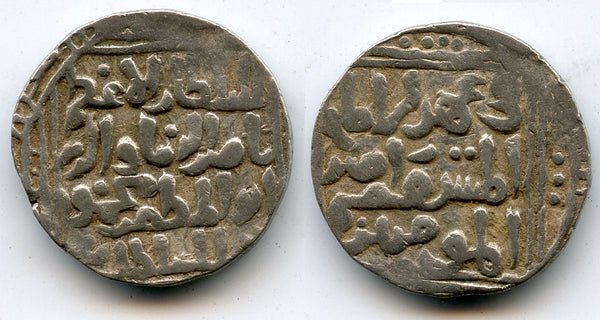
Arabic inscriptions on both sides: Al-sultan al-azzam / Nasir al-dunya wa'l din / abu'l muzaffar Mahmud / ibn sultan within a square and a circular margin with an inscription around, three dots in each segment // Fi 'ahd al-Imam / al-Mustasim / Amir al-muminin ("In the time of the Imam al-Mustasim, commander of the faithful) within a double square, three or more dots in each segment, date and mint name in the margins (off-flan). Mint of Delhi. 28mm, 10.96 grams. "The Coins of the Indian Sultanates" D-138, Rajgor 918.
Citing the last Abbasid Caliph al-Mustasim (1242-1258).
Nasir al-Din Mahmud was the Sultan of the Delhi Sultanate from 1246 to 1266, serving as a largely nominal ruler during a period dominated by his powerful vizier and future successor Ghiyas ud-Din Balban. A son of Iltutmish, Nasir al-Din was known for his personal piety and simple lifestyle, reportedly spending much of his time copying manuscripts of the Qur’an.
The Delhi Sultanate was a series of five Muslim dynasties that ruled much of northern India from 1206 to 1526, beginning with the Mamluk (Slave) dynasty founded by Qutb al-Din Aibak after the decline of the Ghurid Empire. It expanded significantly under rulers like Alauddin Khalji, who strengthened central authority and repelled Mongol invasions, and later the Tughluqs, who attempted ambitious but often unstable reforms. The Sultanate helped spread Islamic culture, administration, and architecture across the region while interacting with existing Hindu traditions. It declined due to internal revolts, weak rulers, and external pressures, ultimately falling after the invasion of Babur, who established the Mughal Empire in 1526 following the First Battle of Panipat.